
Good free game assets help an indie team reach a playable prototype without spending weeks creating every tree, tile, and character. They are also useful for learning an engine, testing level layouts, or replacing placeholder art in a small release.
The challenge is assembling a collection that behaves like a visual system rather than a random assortment. Camera perspective, scale, animation coverage, and license compatibility matter just as much as the appeal of a preview image.
This selection mixes 3D and 2D resources, including low-poly environment kits, character libraries, pixel-art collections, and interface symbols. Some sources publish their own coordinated packs, while others host work from many contributors under different terms.
Use that distinction when planning a download session: a creator’s catalog can establish a coherent style quickly, whereas a marketplace is often better for filling a specific gap that your main kit does not cover.
Before importing a large folder, confirm the free asset license and test a representative file inside the actual engine. A model may require material adjustments, a character may lack the animation you need, and a tileset may use a different grid from the rest of the project.
Keep original archives and permission records together. These small checks make free resources easier to maintain when a promising experiment becomes a game that you want to distribute commercially.
Quick picks at a glance
| # | Resource | License | Best for |
|---|---|---|---|
| 1 | Kenney | CC0 for asset packs; check included notice | Coherent prototypes spanning environments and interface elements |
| 2 | Quaternius | CC0 for published asset packs | Stylized characters and environments for playable prototypes |
| 3 | OpenGameArt | Varies by asset: CC0, CC BY, share-alike and others | Finding specific sprites, textures, models, and animations |
| 4 | itch.io | Creator-specific licenses; inspect each listing | Browsing niche pixel-art and low-poly creator packs |
| 5 | Kay Lousberg | CC0 for the Forest Nature Pack | Building cohesive stylized forests with modular nature assets |
| 6 | CraftPix | Freebie license permits game use; no standalone resale | Ready-made sprites, tilesets, backgrounds, and interface kits |
| 7 | Game-icons.net | CC BY; attribution required | Inventory symbols, abilities, achievements, and status effects |
| 8 | Reiner's Tilesets | Custom graphics license; review conditions | Exploring older rendered sprites and varied model categories |
| 9 | Ansimuz | CC0 for SunnyLand; premium extras separate | Complete side-scrolling prototypes with animated characters |
| 10 | Pixel Frog | CC0 for Pixel Adventure | Learning platformer development with coordinated sprite assets |
Kenney
2D and 3D game kits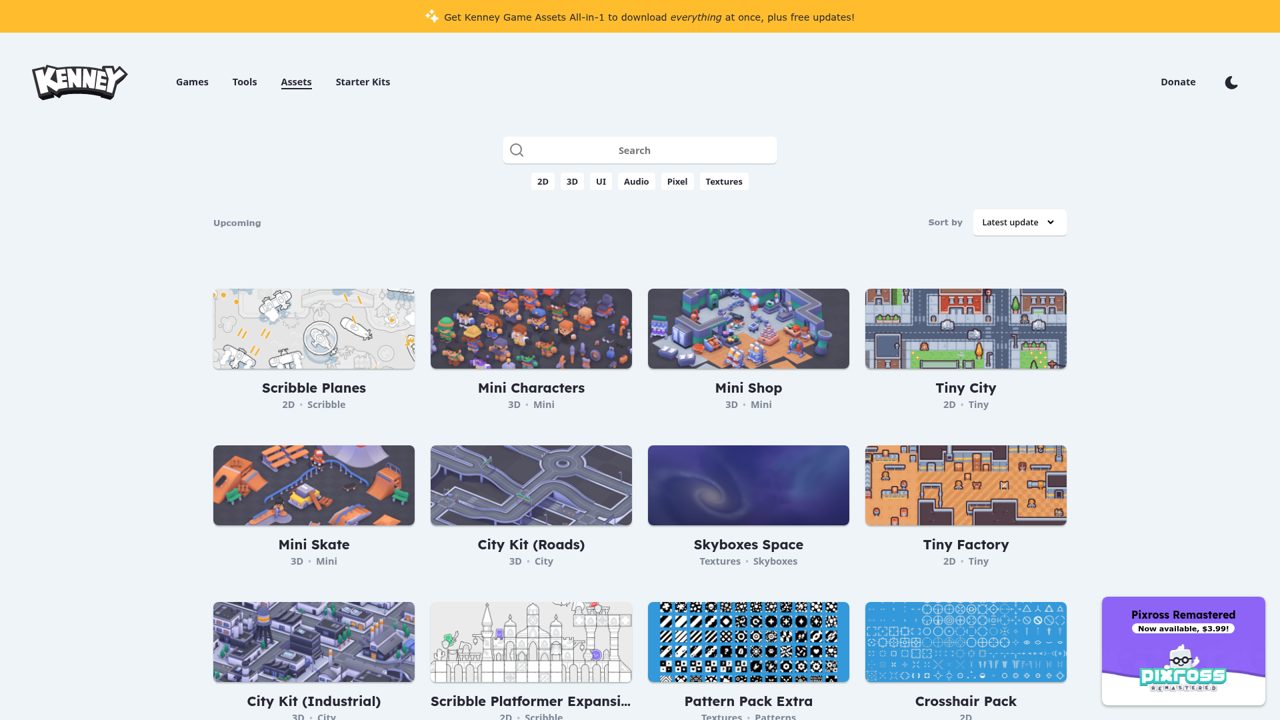
Kenney’s asset library brings together coordinated game development packs, including two-dimensional artwork, low-poly models, and interface elements. Its recognizable emphasis on reusable pieces makes it particularly useful when building a playable slice rather than hunting for a single showpiece model.
Asset packs are offered under CC0 terms, simplifying inclusion in personal and commercial projects without mandatory attribution. Inspect each download for its actual formats and contents before choosing an engine workflow. Start with one environment family, then add supporting UI or props that fit its proportions instead of mixing every available visual style.
- Type
- 2D and 3D game kits
- Best for
- Coherent prototypes spanning environments and interface elements
- License
- CC0 for asset packs; check included notice
- Price
- Free assets; optional paid bundles
Quaternius
Low-poly 3D game packs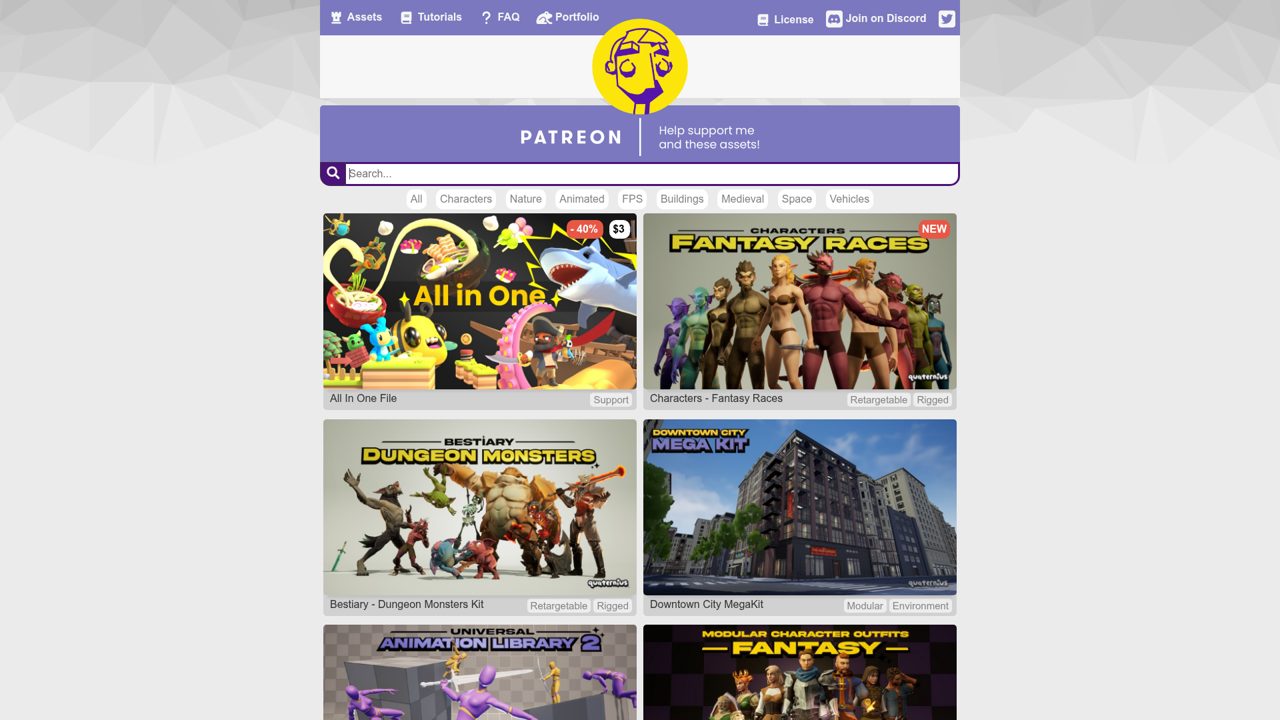
Quaternius focuses on stylized low-poly assets, with themed collections that include characters, props, and environments. Several character packs advertise animations, which can help you evaluate gameplay without building a complete rig from scratch. Its published packs use CC0 licensing, making the library attractive for commercial indie development as well as experiments.
Read the individual pack page for included formats and animation coverage; not every character offers the same actions. Test one model’s scale, material appearance, and movement in your engine before importing an entire collection or designing combat around an assumed animation set.
- Type
- Low-poly 3D game packs
- Best for
- Stylized characters and environments for playable prototypes
- License
- CC0 for published asset packs
- Price
- Free assets; optional support
OpenGameArt
Community game art repository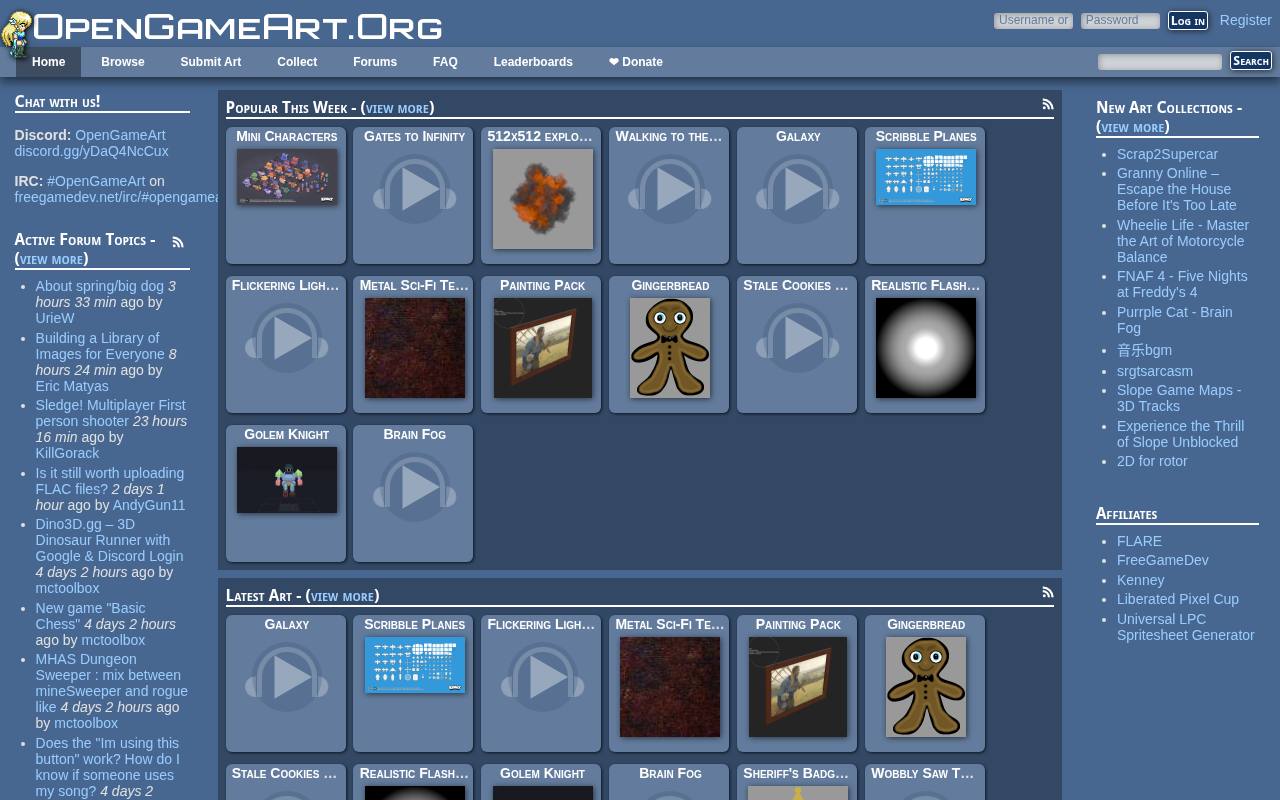
OpenGameArt is a community repository covering multiple game art categories, including two-dimensional artwork, three-dimensional assets, textures, music, and sound. It is especially helpful for searching beyond one artist’s style or locating older community collections with substantial supporting material.
The crucial distinction is per-asset licensing: submissions can use different licenses, and attribution or share-alike conditions may apply. Read the license field and creator notes on the actual submission rather than inferring rights from a search result. Save the author’s preferred credit wording, and avoid treating a curated collection as one uniformly licensed download.
- Type
- Community game art repository
- Best for
- Finding specific sprites, textures, models, and animations
- License
- Varies by asset: CC0, CC BY, share-alike and others
- Price
- Free downloads
itch.io
Independent game asset marketplace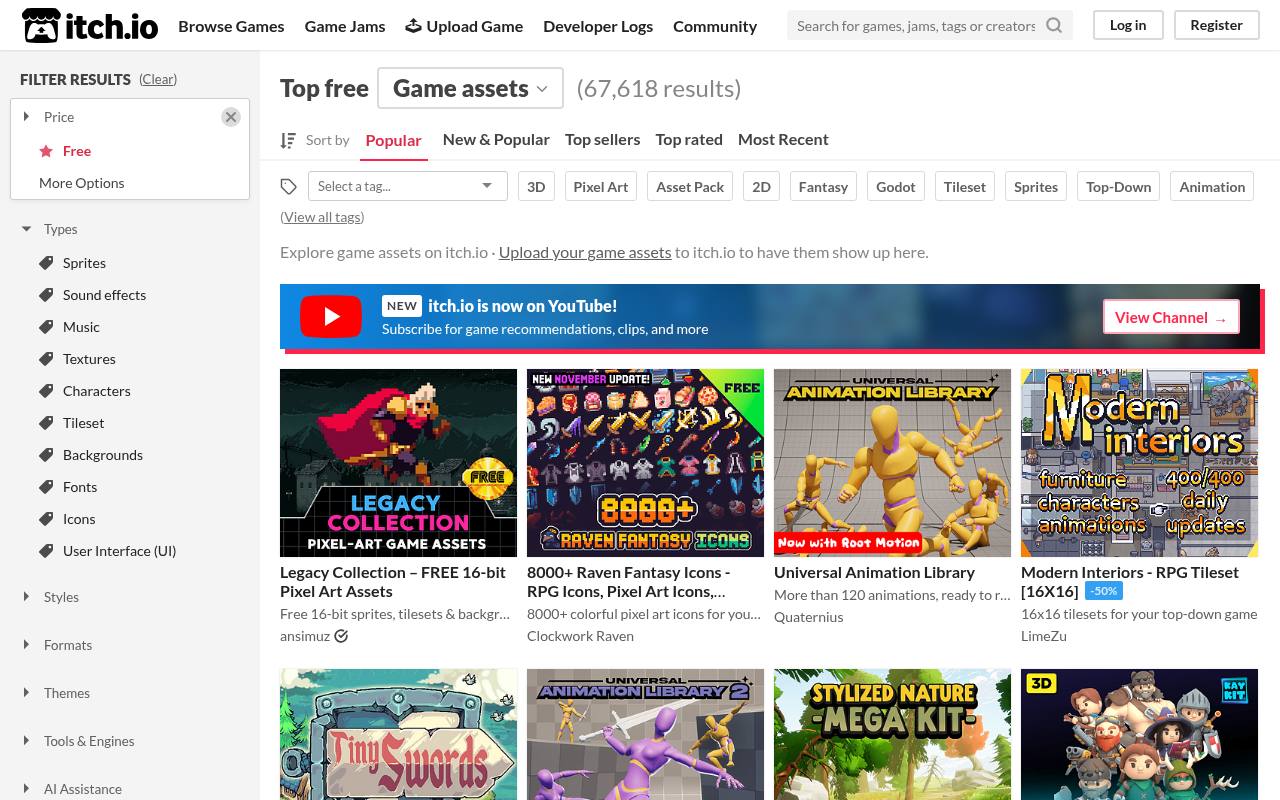
itch.io’s free game-assets section exposes work from a wide range of independent asset creators, from compact sprite sheets to environment kits and interface resources. Tags and browsing categories help narrow the search by art style or intended use. Many listings use name-your-own-price downloads, but payment flexibility is not a substitute for reading the creator’s license terms.
Check which files are included at zero cost, because expanded editions or bonus material may be sold separately. Individual listing pages are also useful for checking updates, comments, and known limitations before committing a game’s visual identity to a pack.
- Type
- Independent game asset marketplace
- Best for
- Browsing niche pixel-art and low-poly creator packs
- License
- Creator-specific licenses; inspect each listing
- Price
- Free listings + paid assets
Kay Lousberg
Low-poly environment models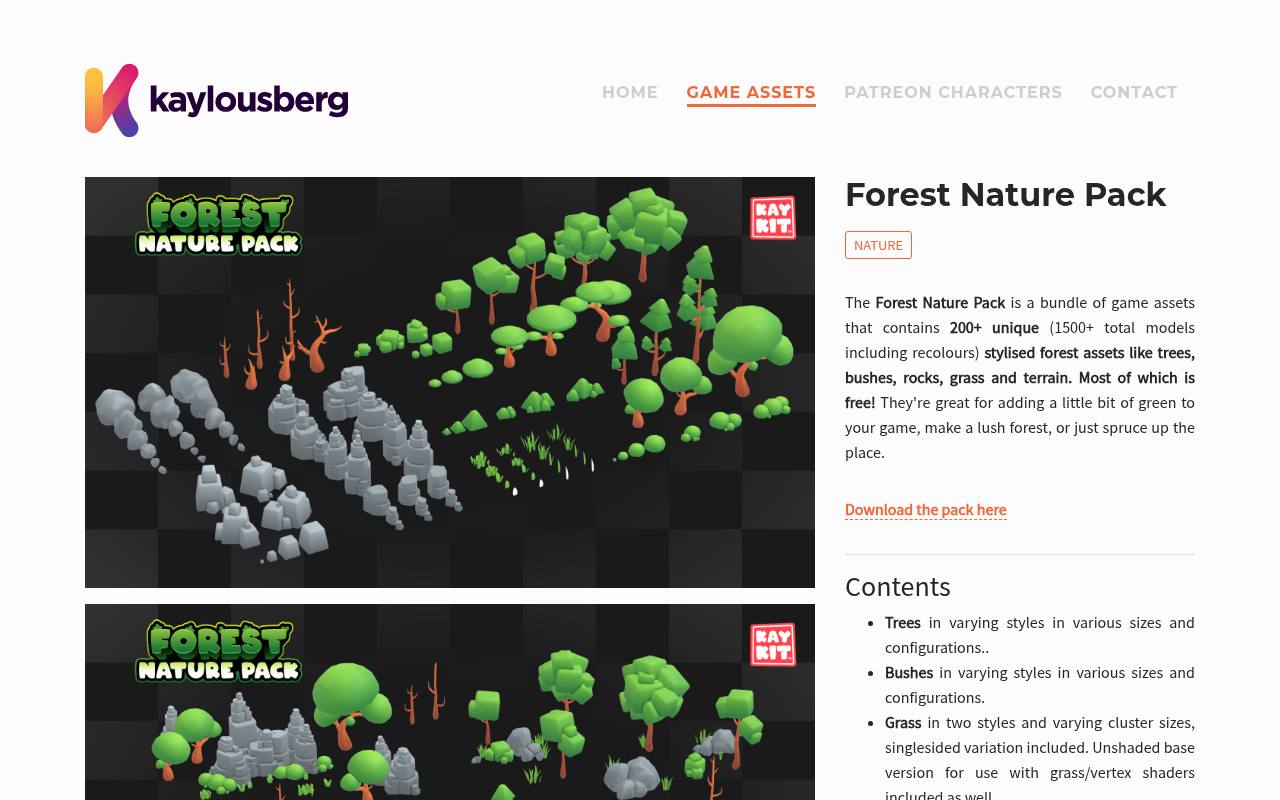
Kay Lousberg’s Forest Nature Pack supplies stylized low-poly vegetation and landscape objects with a clearly described free tier. The product page lists trees, rocks, bushes, and grass in that tier, with additional variations and terrain in the expanded offer.
It identifies FBX, glTF, and OBJ files and describes CC0 commercial permissions without required attribution. A shared gradient-atlas approach helps the collection maintain a coordinated look. Inspect the free download’s exact contents before planning a whole biome, particularly if your layout depends on the terrain pieces or extra variations reserved for the larger edition.
- Type
- Low-poly environment models
- Best for
- Building cohesive stylized forests with modular nature assets
- License
- CC0 for the Forest Nature Pack
- Price
- Free tier + paid extras
CraftPix
2D game art collections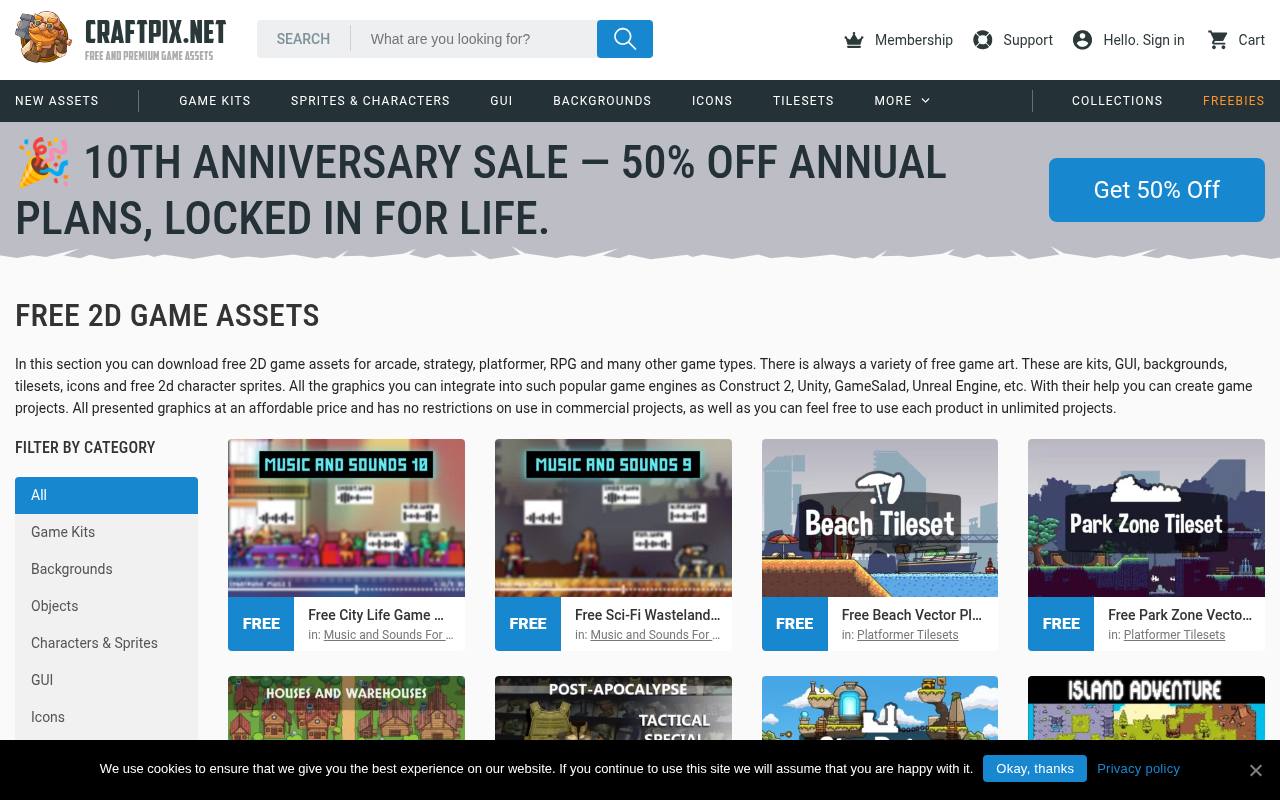
CraftPix maintains a dedicated freebies section for two-dimensional game artwork, alongside its paid catalog. The site separates categories such as characters, game kits, backgrounds, GUI, objects, and tilesets, making it useful when a prototype needs several connected visual components.
Check the selected free product for its file contents and animation states rather than assuming every preview frame is included. Its game asset licensing is not permission to repackage the artwork as your own standalone stock collection. Keep the freebie’s terms with the archive and verify any project-specific redistribution questions before sharing editable assets outside the development team.
- Type
- 2D game art collections
- Best for
- Ready-made sprites, tilesets, backgrounds, and interface kits
- License
- Freebie license permits game use; no standalone resale
- Price
- Freebies + paid packs
Game-icons.net
SVG and PNG interface icons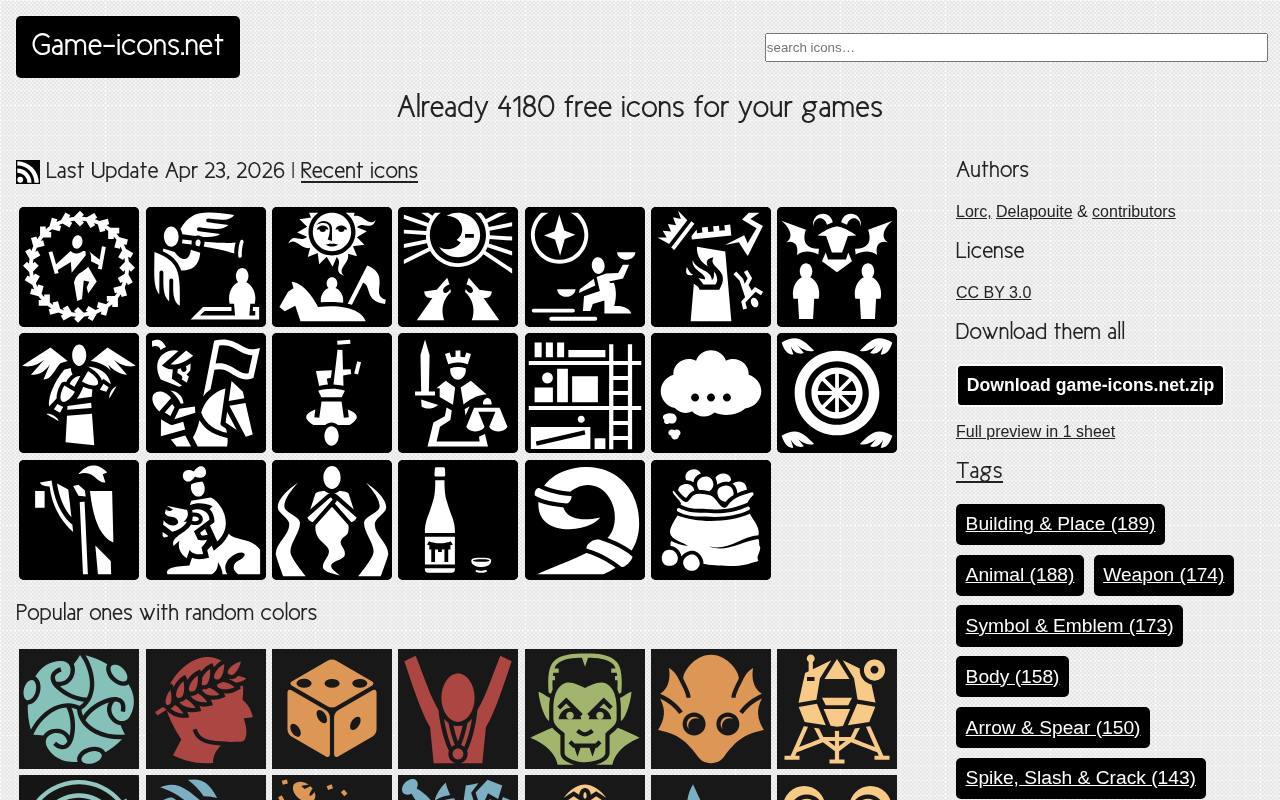
Game-icons.net concentrates on game-oriented symbolic icons, filling a different role from environment and character libraries. Its catalog is useful for inventories, skill trees, status effects, and prototype menus where readable silhouettes matter more than detailed illustration. Downloadable SVG and PNG options support both scalable editing and direct bitmap use.
The collection uses Creative Commons attribution licensing, so follow the site’s credit instructions and preserve author information for the icons you choose. Test symbols at actual interface size, because a dramatic preview can still become too intricate when squeezed into a small hotbar slot.
- Type
- SVG and PNG interface icons
- Best for
- Inventory symbols, abilities, achievements, and status effects
- License
- CC BY; attribution required
- Price
- 100% free
Reiner's Tilesets
2D sprites and 3D graphics archive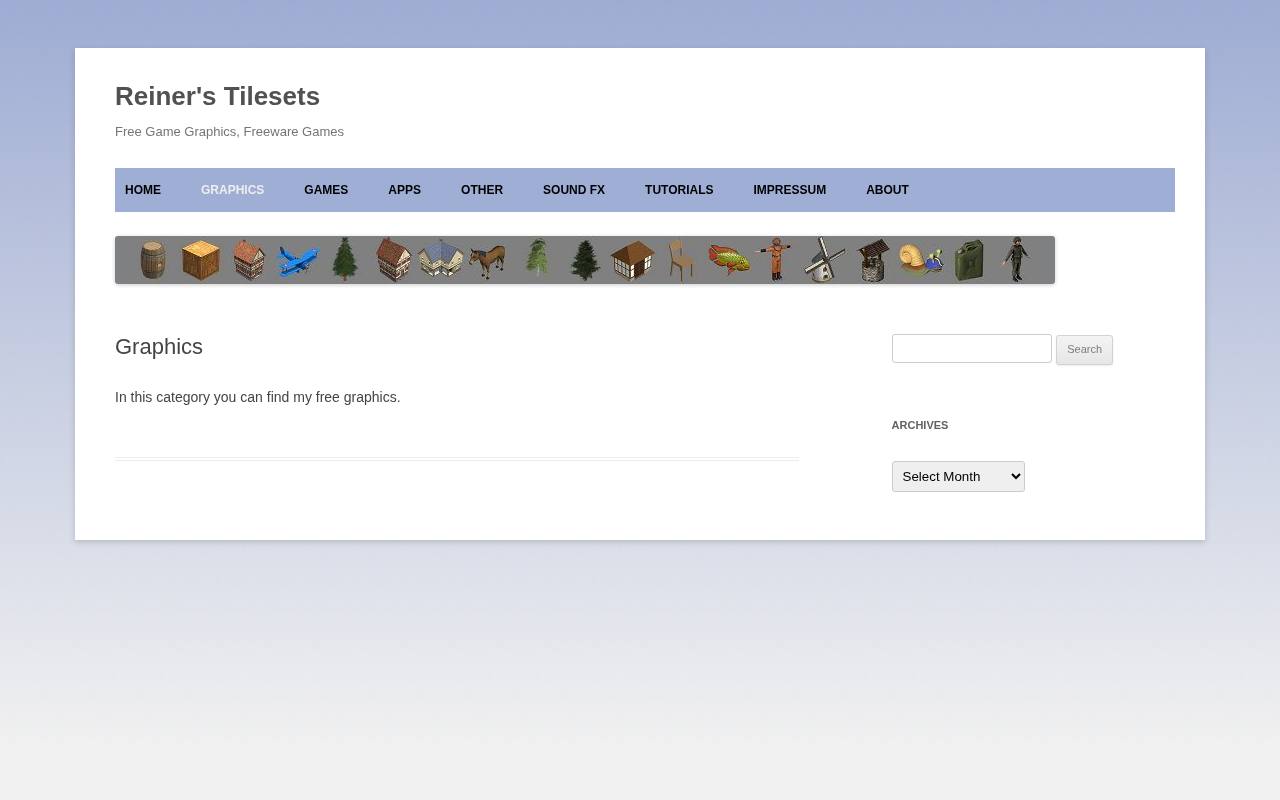
Reiner’s Tilesets organizes a long-running graphics archive into 2D and 3D categories, including animals, humans, buildings, environments, furniture, and plants. This breadth can help developers working on prototypes or looking for an older rendered-sprite aesthetic rather than current low-poly trends.
The site has a dedicated graphics license section, which should be read before distributing a project; do not assume its free downloads are CC0. Check each archive for format, camera angle, and animation directions. Older resources may need conversion or material repair, so evaluate one representative asset before adopting a large collection.
- Type
- 2D sprites and 3D graphics archive
- Best for
- Exploring older rendered sprites and varied model categories
- License
- Custom graphics license; review conditions
- Price
- Free graphics
Ansimuz
Pixel-art platformer kit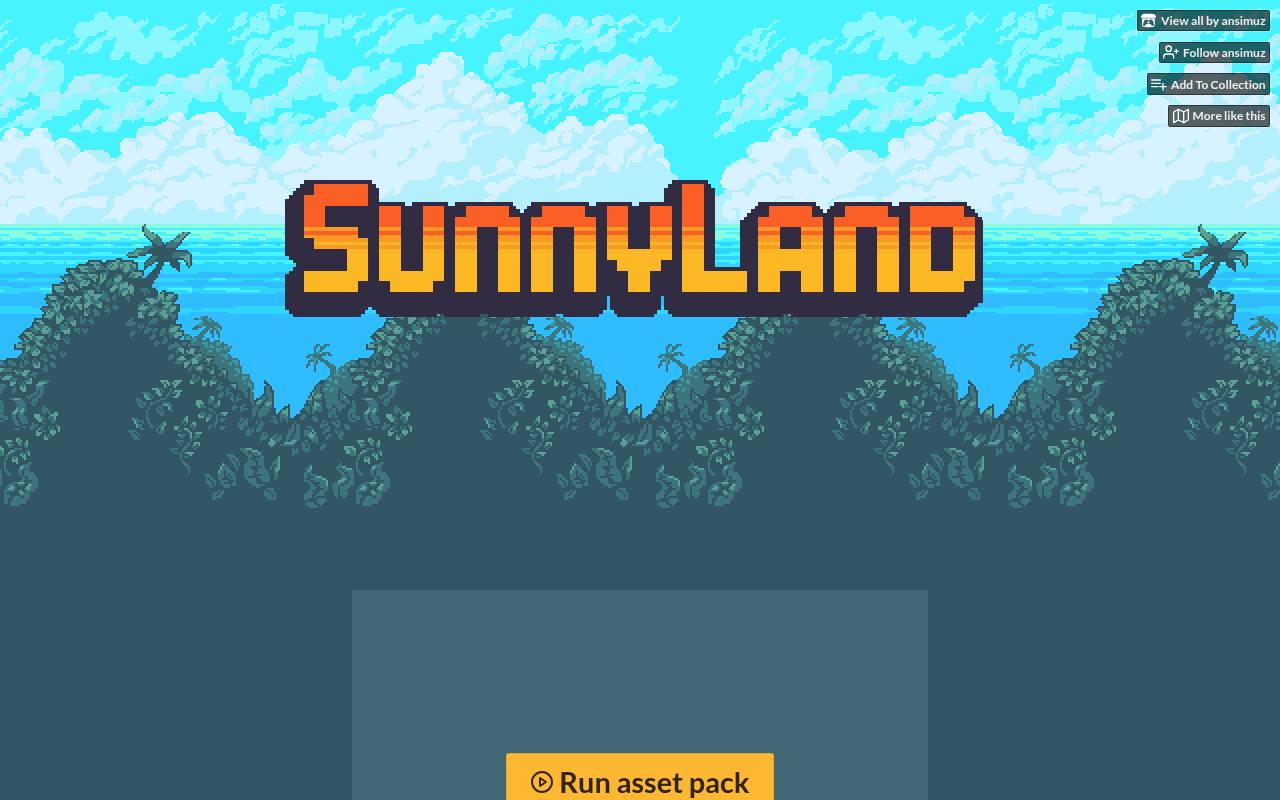
Ansimuz’s SunnyLand page offers a pixel-art platformer kit built around a colorful side-scrolling world. The listing describes animated player characters and enemies, with supporting items and terrain artwork that can establish a playable scene quickly. Its asset-license field identifies Creative Commons Zero, while the download area also needs checking for any separately priced additions.
Use the core free files as a coordinated starting point rather than assuming every optional expansion is included. Before implementing movement, inspect the available animation frames, sprite dimensions, and ground alignment so collision and animation timing match the supplied art.
- Type
- Pixel-art platformer kit
- Best for
- Complete side-scrolling prototypes with animated characters
- License
- CC0 for SunnyLand; premium extras separate
- Price
- Free pack + optional paid extras
Pixel Frog
Pixel-art character and environment kit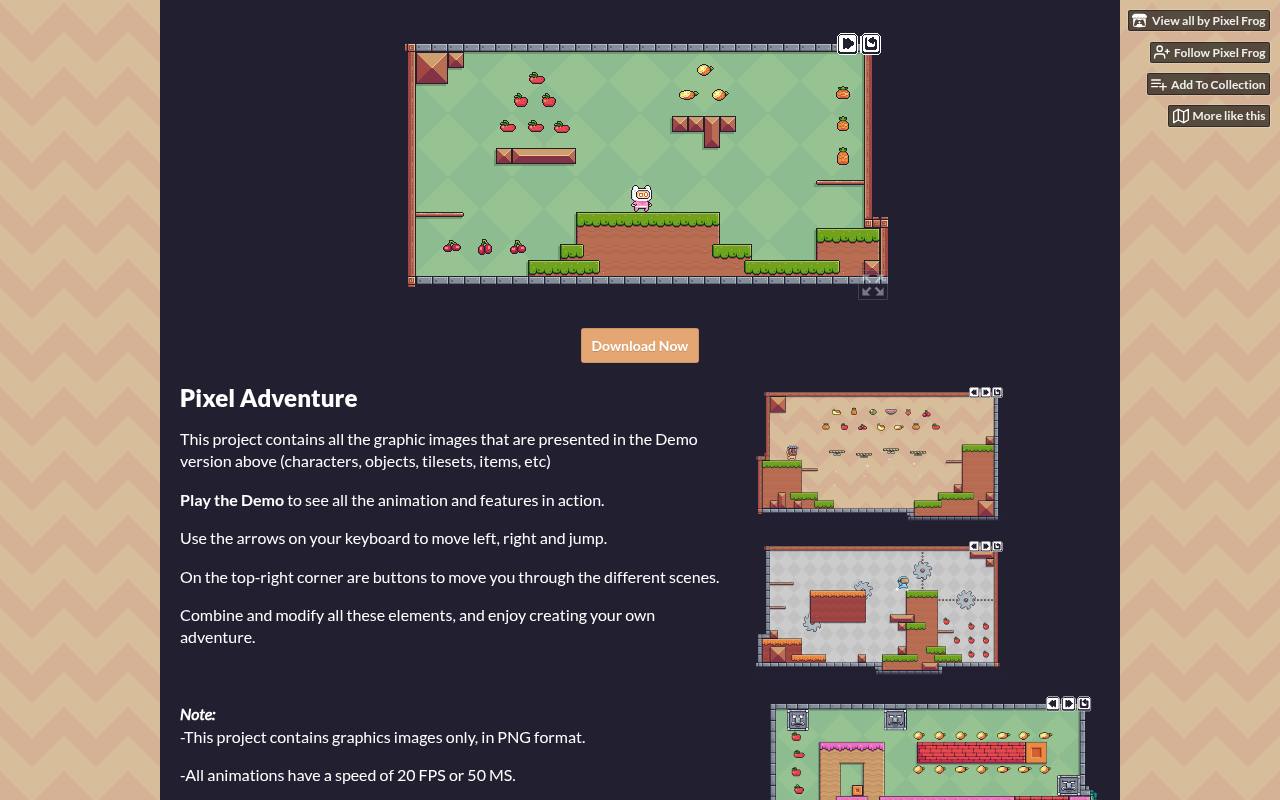
Pixel Frog’s Pixel Adventure collection is a useful source of playful platformer sprites, with character animations and supporting level artwork presented as a cohesive kit. The listing’s CC0 terms make it an approachable choice for learning projects and commercial experiments, while optional support is distinct from the right to use the free pack.
Examine the sprite animation coverage before designing mechanics, since the presence of a character alone does not guarantee every action your controller needs. Keep pixel dimensions and filtering consistent when combining the artwork with other packs to preserve crisp edges and a stable visual scale.
- Type
- Pixel-art character and environment kit
- Best for
- Learning platformer development with coordinated sprite assets
- License
- CC0 for Pixel Adventure
- Price
- Free download; optional support
Choose one visual foundation
Begin with a main pack that can cover most of the game’s visible world. Consistent art direction depends on more than color: perspective, proportions, outline weight, texture density, and animation style all affect whether assets belong together. Build a small test scene with a character, a few environment pieces, and the intended interface before downloading dozens of extras.
If an outside object clashes, adjusting a palette may not fix incompatible shape language. It is often faster to simplify a scene around a strong existing kit than to force several unrelated packs into a supposedly unified world.
Record licensing before importing
Create an asset permission register containing the pack name, creator, source URL, license, and any required credit. Keep it beside the untouched download archives so the information survives file renaming and engine imports. CC0 can simplify reuse, while attribution licenses require a reliable credit process and other terms may need closer examination.
A free marketplace filter does not standardize those obligations. If a resource offers several licensing choices, record the one you are relying on. Review redistribution permissions separately when publishing a mod kit, open project, or editable sample that exposes the original asset files.
Test models in the actual engine
For three-dimensional packs, check scale and orientation as soon as one model imports. Confirm material assignments, texture paths, normals, and the appearance of transparent surfaces under the lighting you intend to use. Characters need additional checks for rig structure, animation clips, root movement, and deformation.
A good preview on the creator’s page cannot establish that every engine importer will interpret the files identically. Create a repeatable import preset only after testing a representative prop and character. This reduces the risk of correcting hundreds of assets later because the first batch arrived with an unnoticed unit mismatch.
Keep pixel art genuinely consistent
For two-dimensional packs, establish a shared pixel density before combining characters, tiles, and backgrounds. A character drawn for one tile scale can look oversized or unusually detailed in another environment even if both packs use similar colors. Inspect sprite origins, animation frame sizes, padding, and atlas settings in the engine.
Choose filtering deliberately and test camera movement for shimmering or uneven pixel steps. Avoid repeatedly resizing source sprites to make them fit an improvised grid. If rescaling is unavoidable, evaluate the whole scene at its intended resolution rather than judging isolated assets enlarged in an image editor.
Budget for runtime performance
Free assets still carry runtime production costs through geometry, textures, materials, and animation. Populate a representative level section and profile it on realistic target hardware before assuming a low-poly appearance guarantees good performance. Large numbers of separate objects or material changes can matter even when each mesh is simple.
For sprite games, examine atlas organization and texture memory rather than focusing only on file download size. Optimize based on measurements from your engine, keeping untouched originals available. Do not damage a reusable source collection with irreversible reductions merely to solve a temporary prototype bottleneck.
Plan how prototypes become finished games
A free kit can remain in a shipped release when its license permits it, but plan for distinctive final presentation rather than relying on exclusivity. Level design, lighting, composition, effects, and a coherent interface can give familiar assets a recognizable identity.
Keep gameplay systems independent of fragile filenames or one specific character rig where practical, so replacements do not break the whole project. Before release, audit missing credits, test every visible animation state, and remove unused files from the build. Thanking creators is also worthwhile when not required: it helps players discover the people whose work supported the game.